




Inside ofi’s first comprehensive sustainability roadmap for spices
Key takeaways
- ofi targets crop-specific sustainability goals, focusing on unique challenges and ensuring long-term resilience for farmers and supply chains.
- The company leverages AI, digital traceability, and precision agriculture to optimize resources, reduce emissions, and support fair pricing.
- Through Spice Maps, ofi is creating climate-resilient, regenerative spice supply chains, with 2030 targets that include bringing 2 million hectares under regenerative agriculture.
F&B ingredient supplier ofi has launched Spice Maps, its first comprehensive sustainability strategy for spices, alongside the annual Nut Trails impact report. Together, these frameworks demonstrate the company’s efforts to establish resilient and sustainable supply chains for two of the world’s fastest-growing ingredient categories.
Both roadmaps are part of ofi’s wider strategies, which focus on farmers, communities, climate action, and regenerative agriculture, as well as aligning with its 2030 targets that include a newly validated Science Based Targets initiative (SBTi) pathway.
Food Ingredients First speaks with Burcu Turkay, global head of Sustainability for Nuts and Spices at ofi. She explains how Spice Maps sits within the company’s overarching sustainability strategy, Choices for Change, which is built around four impact pillars: Prosperous Farmers, Thriving Communities, Climate Action, and Regenerating the Living World.
“Spice Maps translates these pillars into specific, measurable actions and targets for each of our six core spice products — pepper, chili, turmeric, onion, cassia, and coconut — grounded in the unique realities of each origin.”
“The diversity of crops and origins in our spice supply chains needs to be reflected in our approach and actions on the ground. For instance, with onion-growing regions increasingly prone to drought, piloting new technologies to drive regenerative practices is a priority for optimizing water use and reducing on-farm inputs.”
“In India’s chile-growing regions, meaningful interventions for building supply chain resilience focus on delivering training and technical support to smallholder farmers alongside improving access to healthcare and education for the broader farming community.”
Turkay further notes that by targeting the specific challenges facing farmers in each crop and country, “ofi can set goals that reflect local realities — and track progress that matters both to the communities we work with, their landscapes, and our customers.”
Spice Maps: Tailored sustainability for priority spices
Operating across the major spice-growing regions of the US, Mexico, India, Egypt, Vietnam, Indonesia, and Cambodia, ofi’s new Spice Maps strategy sets distinct 2030 targets for pepper, chile, turmeric, onion, cassia, and coconut — recognizing that each spice has unique production challenges.
“ofi’s strong roots in key growing regions and integrated processing capabilities position us to supply our customers with authentic, sustainable ingredients that deliver exceptional flavor and functionality,” explains Turkay.
“This includes sustainable onions developed from our proprietary seed, designed to enhance yields and reduce water usage, as well as a range of upcycled chili sauces that offer an innovative, clean label way to elevate meals. At the same time, we create value for the farmers and landscapes behind these ingredients through tailored programs, strategic partnerships, and advanced digital tools.”
Turkay believes Spice Maps is “the roadmap for working with customers and partners to build more resilient spice supply chains by making choices that help farmers prosper, protect the rights of children, and promote regenerative agriculture.”
Technology driving impact from farm to factory
AI and automation are already delivering results across ofi’s operations. In its California, US, almond orchards, AI-powered soil sensors optimize irrigation while smart-spraying technology reduces herbicide use by up to 80%, ofi reports.
In Côte d’Ivoire, ofi’s award-winning geo-location app digitally screened 22,000 children for malnutrition and referred 370 for treatment.
“AI is also supporting the adoption of solar power, enabling ofi’s almond operations to offset 56% of Scope 1 emissions in 2024. At our Kerabury orchards in New South Wales, Australia, a solar power plant has been installed featuring over 10,000 sun-tracking panels to provide up to 83% of the orchard’s energy needs and reduce annual emissions by 5,500 tCO2e,” says Turkay.
According to Turkay, 4,186 additional cashew and hazelnut farmers were registered to ofi’s direct sourcing network last year (total 47,988) via its farmer information survey tool, with over 31,450 cashew and hazelnut farmers supported with context-specific interventions.
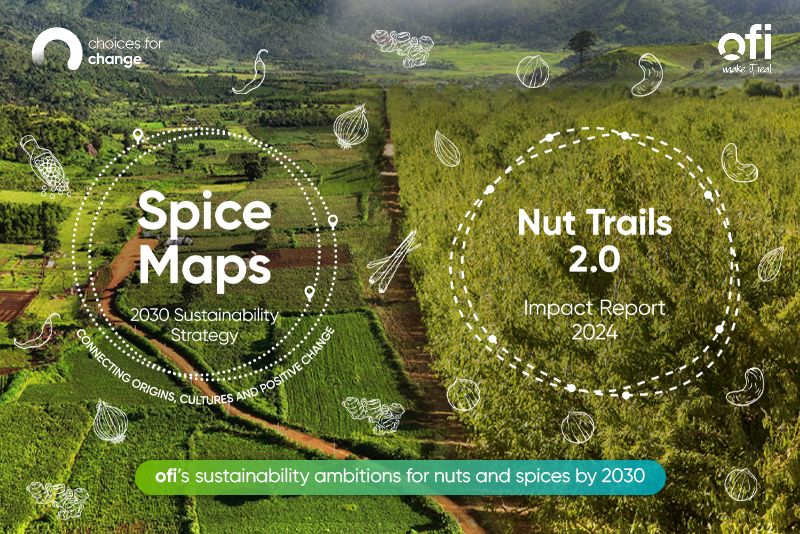 ofi has launched Spice Maps, its first comprehensive sustainability strategy for spices, alongside the annual Nut Trails impact report.“In Cambodia, 3,000 pepper farmers are using the ofi Direct app to connect directly with buyers, creating full traceability and a fairer, more transparent procurement process,” she shares.
“The vast wealth of data that we’re collecting from across the full supply chain makes our impact real and measurable. From this data, we can generate relevant insights and verified traceability that customers can access through our sustainable sourcing solution, AtSource.”
Strengthening traceability and farmer support
For ofi, regenerative agriculture means climate adaptation, livelihood resilience, and ecosystem regeneration aligned with industry standards. The company’s formalized regenerative agriculture framework guides field teams in designing effective, context-specific interventions while providing a consistent framework for measuring impact.
Dedicated 2030 targets include expanding regenerative practices across 9,000 hectares of onion, 6,000 hectares of cassia, 2,000 hectares each for black pepper and chili, and 1,000 hectares of turmeric.
These contribute to ofi’s total target under Choices for Change to bring two million hectares under regenerative agriculture in ofi’s global supply chains by 2030.
SBTi-validated 2030 targets and beyond
ofi’s SBTi-validated corporate targets mean the company can offer its customers low-carbon products backed by science.
Turkay explains: “We make our sustainability progress measurable and accessible through our sustainable sourcing solution, AtSource, which provides customers with verified traceability and key metrics that can support corporate reporting and improve sustainability performance through working with ofi as their implementation partner.”
Furthermore, by targeting the specific challenges facing farmers in each crop and country, ofi is able to set goals that reflect local realities and track progress that matters to communities, landscapes, and its customers.
“We’re leveraging over 20 years of sustainability experience and deep farming relationships to create tailored solutions for the world’s biggest food and beverage brands — delivering both flavor and functionality, from clean label spice blends to protein-rich nut ingredients,” adds Turkay.
“Our ongoing investment in data systems, traceability, and direct engagement at origin is fundamental to building supply chains that are resilient, sustainable, and capable of meeting the evolving demands of our customers, while making a real difference for people and the planet,” she concludes.
Earlier this year, ofi was rated the most advanced company in the 2023–2024 Platform Living Wage Financials benchmark for the Food Agri and Food Retail sectors. The assessment evaluated 22 companies on their efforts to enable a living income for smallholder farmers.