




Grainge AI: Solving the ingredient testing “blind spot” with machine learning
Key takeaways
- Grainge AI develops software to help manufacturers identify which ingredient measurements matter, addressing what founders call industry blind spots in testing protocols.
- The start-up uses machine learning rather than language models for accuracy-critical manufacturing decisions, targeting mid-size co-manufacturers with formulation challenges.
- The company aims to transform food formulation from reactive chore into proactive tool within one to two years for major customers.

Food manufacturers are making critical production decisions based on faulty metrics that are outdated, according to US-based Grainge AI — a start-up developing machine learning tools to help F&B companies identify and predict ingredient behaviors in formulations.
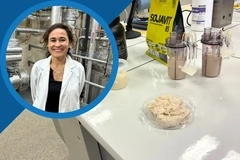
Grainge AI, founded 18 months ago by food chemistry and AI researchers from the University of California, UC Davis, is building software that determines optimal testing protocols for ingredient applications. The company targets what co-founder and CEO Tarini Naravane calls a “measurement blind spot” across the food industry.
“You could measure 10,000 things, but which one is the thing that’s important for you?” Naravane tells Food Ingredients First. “That’s the problem we solve. The big question everyone is asking is, ‘what data should I measure?’”
Co-founder and CTO Gabriel Simmons says the problem is widespread in food manufacturing. “People are making important decisions, for example, setting process parameters based on metrics that are sometimes 50–100 years old, like how much protein is in this grain,” he explains.
“There are much more detailed measurement technologies available, but sometimes those can be more expensive. So then folks naturally have a question: Do I really need this measurement if I have this much more to spend?”
The result is that manufacturers know existing metrics are inadequate but lack clarity on which newer measurements justify the additional cost. The uncertainty leads to wasted laboratory spending and conflicting expert advice, according to Naravane.
Machine learning for measurement selection
Grainge AI’s approach uses machine learning models to identify which data points are most informative for specific manufacturing problems. The company is developing software tools that integrate with customer data infrastructure to answer measurement selection questions.
“Machine learning models can be used to tell you which data is the most informative,” Simmons says. “They provide a very natural solution to figuring out what data is relevant to this problem in a way that will take humans many times longer.”
The company’s approach differs from recent AI applications in food that rely on large language models like ChatGPT. While LLM-based systems can automate some business processes, Simmons notes they face reliability challenges with failure rates of around 15%.
“When it comes to problem settings that require the utmost accuracy and reliability, you want those solutions to be grounded in data that comes from the problem you’re working on,” he says. The company does use LLM agents internally for some tasks, but relies on data-driven machine learning for its core manufacturing applications.
Real-time manufacturing focus
The start-up concentrates on real-time production challenges rather than new product development. Naravane describes scenarios where manufacturers receive new ingredient batches and must make rapid formulation adjustments.
“We’re solving manufacturing efficiency, which means in real time you’ve got very little time before you fix the problem,” she says. “It’s more real-time issues.”
The company targets mid-size co-manufacturers and ingredient suppliers facing formulation challenges. This includes maintaining consistent product performance or nutrition labels despite ingredient variations, and determining optimal applications for non-traditional ingredients from side streams.
For data collection, Grainge AI integrates customer data where available and works with a network of contract research organizations that can perform relevant measurements. The company is also building partnerships with method development laboratories that create quality testing protocols.
“They’re not our customers, they’re more collaborators,” Naravane says. “We can think ahead to what are going to be these novel use cases and novel ingredients.” Grainge AI targets what co-founder and CEO Tarini Naravane calls a “measurement blind spot” across the food industry.
Industry perception challenges
Beyond typical start-up obstacles around customer acquisition, the founders identify misperceptions about AI capabilities as a key challenge. Many companies dismiss AI applications based on limited exposure to language models.
“Sometimes perceptions of AI are a little bit one-sided,” Simmons says. “People come to the table with an idea about what AI is, and it’s maybe 5% of what AI is actually capable of, or 5% of the forms that it can take. They may have written off in their minds the possibility that AI can work for them when, in fact, there is a different kind of AI that could have been solving their problems already.”
He notes that competition over the most human-like AI systems doesn’t necessarily correlate with business success. “For some business problems, you actually don’t need that,” he says.
Origin and future direction
Naravane’s interest stems from managing foodservice operations in Germany, where she handled events ranging from 500–10,000 people and faced constant recipe reformulation while minimizing food waste costs.
Rather than pursuing consulting work, she sought a data-driven technical approach and studied food chemistry at UC Davis, US. She met Simmons, who had been working on AI topics since 2018, at the university’s AI Institute for Food Systems.
The company currently focuses on texture applications, which Naravane selected because incorrect texture prevents products from functioning in manufacturing lines. However, she identifies flavor profiles as a future frontier.
Looking ahead, Naravane emphasizes comprehensive ingredient understanding. “We have waste streams, we’re using ingredients to do things they’ve never done, we’re finding new sources of ingredients,” she says. “Really being able to understand what an ingredient does is a very deep topic, and will make lots of uses possible.”
Simmons aims to transform the formulation process from a reactive chore into a proactive tool. “I would like the food industry to be in a state where food formulation is no longer this daunting chore that you have to do reactively because the environment has changed on you,” he says. “It should be something that’s easy to do, and you can do it proactively whenever you want and feel confident that the solutions you’re getting are the right ones.”
He cites achieving this transformation for several major customers within one to two years as a near-term milestone.
Naravane adds that data privacy remains a priority. “We are very responsible with the data we get from our customers,” she says. “We know privacy and security is very important for all of our customers.”