




How Cargill is leveraging fermentation to tackle the protein challenge
Key takeaways
- Cargill positions fermentation not as a standalone R&D tool but as an end-to-end industrial capability, spanning strain development, scale-up, and commercial production.
- The company advances three complementary fermentation pathways to improve protein quality, diversify sources, and target high-value applications.
- By focusing on hybrid products and industrial scale, Cargill sees fermentation as a practical way to deliver high-quality protein with lower reliance on animal sources.
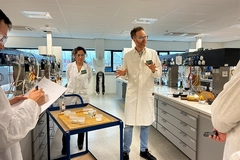 Cargill’s Paula Garcia, senior director of R&D, and Ruben Jolie, R&D manager for Fermentation.
Fermentation is one of humanity’s oldest food practices — but today, advances in biotechnology are turning this ancient process into a modern industrial platform. Food ingredient leaders like Cargill are leveraging fermentation to meet rising demand for high-quality protein with reduced reliance on animal sources, while lowering the environmental footprint of food production.
During a recent tour of its European Innovation Center in Vilvoorde, Belgium, Cargill told Food Ingredients First it is positioning fermentation as an integrated, end-to-end industrial capability, rather than a standalone R&D activity.
“Fermentation in itself is not new — the fermentation revolution happened centuries ago, when our ancestors figured out they could extend the shelf life of food, like milk, to produce cheese or yogurt,” says Paula Garcia, senior director of R&D at Cargill.
“Fermentation is one of the most well-established biotechnologies used in food, and what we do today is build on that heritage to move the frontier of fermentation toward solutions that meet today’s needs.”
Cargill connects strain selection and engineering, feedstock optimization, process design, downstream purification, and ingredient formulation to bridge the gap between lab-scale experimentation and commercial production.
The company’s high-throughput screening and pilot-scale fermentation enable faster process development, with a focus on reproducibility, food safety, and regulatory compliance. Its approach combines in-house infrastructure with partnerships across academia, start-ups, and customers.
For Cargill, this integration is designed to overcome one of fermentation’s biggest hurdles: reliably translating laboratory success into food-grade production at commercial scale.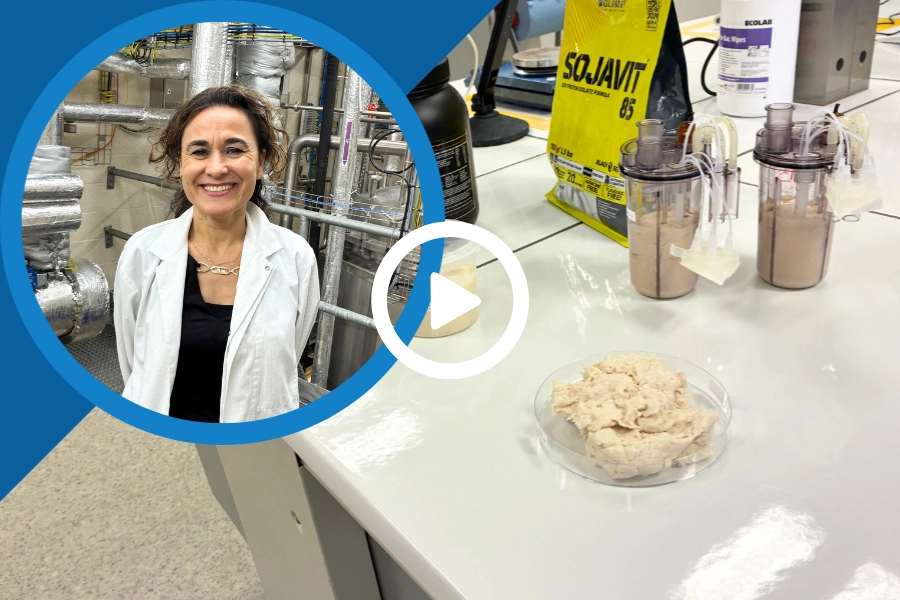 Paula Garcia, senior director of R&D, shares insights from Cargill’s industrial-scale fermentation room on how biotechnology is reshaping food innovation.
The three protein pathways
Cargill is pursuing three distinct but complementary fermentation-driven protein strategies: plant-enhanced, microbial, and precision.
The company harnesses fermentation to improve plant proteins — not replace them. Through fermentation, plant-based proteins can be finetuned to address longstanding challenges around taste, digestibility, and functionality, enabling their use in a wider range of food applications.
“We enhance the properties of plant-based proteins using fermentation to finetune their functionality, digestibility, or taste,” explains Garcia, pointing to fermented pea protein formats designed to deliver creaminess and texture closer to dairy.
This focus improves ingredients that food manufacturers already use, reducing reformulation risk while expanding where plant proteins can realistically compete.
Cargill’s second pathway centers on microbial proteins, including mycoprotein derived from fungi. These proteins are not intended as full substitutes, but as complementary ingredients that can be blended with animal or plant proteins.
“With microbial proteins such as mycoprotein, we can diversify products consumers are already familiar with,” continues Garcia, highlighting applications like burgers and nuggets. “By introducing mycoprotein, we can maintain the sensory experience consumers expect, while improving nutrition and reducing certain ingredients like saturated fats.”
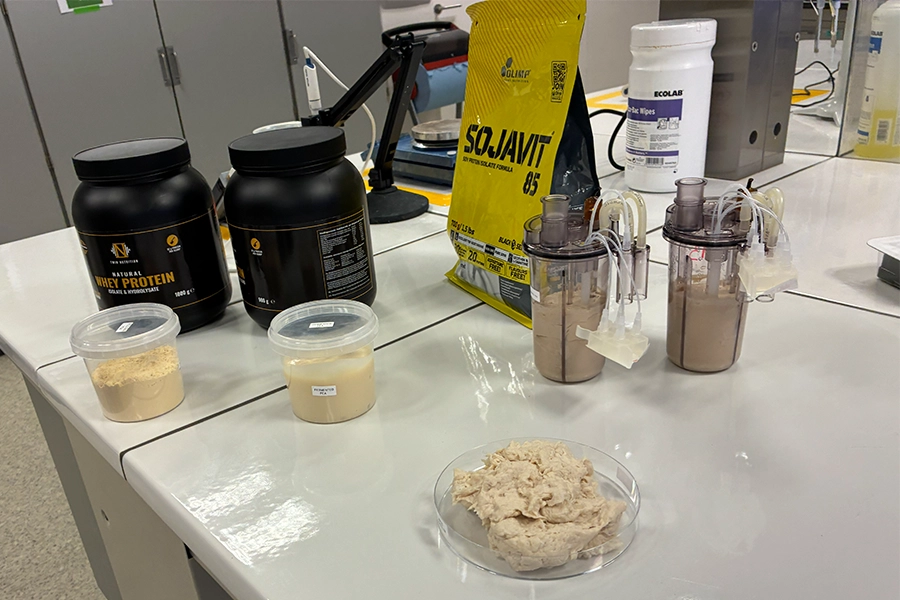 Cargill’s fermentation strategy spans plant-enhanced, microbial, and precision protein pathways.Cost and accessibility also feature prominently. By blending microbial protein into conventional formulations, Cargill argues it is possible to lower overall product costs while improving protein and fiber content — a strategy aimed at broadening adoption beyond niche consumer segments.
Cargill describes its third pathway, precision fermentation, as the most targeted and application-specific. Fermentation is used to produce specific proteins that are today mostly sourced from animals, particularly where defined nutritional or functional properties are required, such as sports supplements and medical nutrition.
“We use precision fermentation to target specific proteins that today are limited to animal sourcing, allowing us to reach these products with controlled quality and high reproducibility, while reducing reliance on animal supply chains,” says Garcia.
Rather than positioning precision fermentation as a mass-market solution, Cargill frames it as a way to unlock high-value ingredients where performance, consistency, and safety are critical.
Why hybrids win in the near term
For Cargill, the fastest path to mainstream adoption is not a hard pivot away from animal protein — it’s blending. The company’s experts frame the “protein transition” as incremental, arguing that hybrid products can deliver sustainability and nutrition gains without asking consumers to trade down on taste, texture, or familiarity.
“The protein transition is not something that requires a radical change in consumer dietary patterns,” says Garcia. “Instead, it’s the incremental, adjacent move toward a more sustainable approach that will move the needle.”
“Take, for instance, nuggets or burgers that today are largely animal-based. By introducing mycoprotein we can maintain the sensory experience consumers expect, while improving the nutritional profile — protein and fiber — and reducing ingredients such as saturated fats or sugars.”
Hybrids can also support “more affordable propositions” by blending microbial proteins into conventional formulations, broadening the addressable market beyond early adopters. “We also improve the costs of products, enabling a broader range of the population to take advantage,” adds Garcia.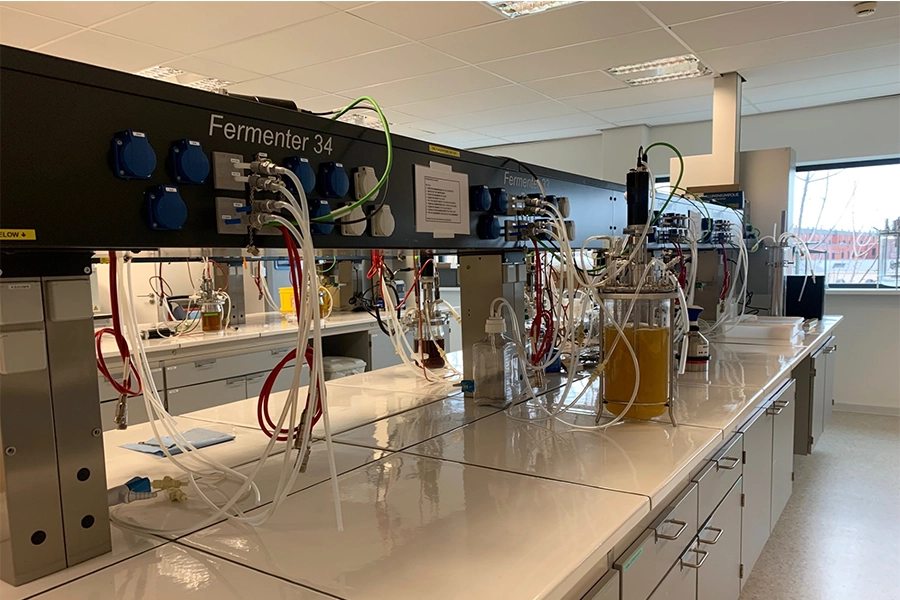 Pilot-scale fermentation bridges the gap between lab research and commercial protein production.
Making fermentation work at scale
Throughout the tour, Cargill was clear that fermentation’s real test is not scientific feasibility, but scale, stressing that laboratory success matters more if it can be translated into safe, repeatable, food-grade production.
As Ruben Jolie, R&D manager for Fermentation at Cargill, explains, this translation is complex and multidisciplinary. “It’s not super complex, not super easy either — it really requires bringing together expertise from different disciplines — from strain development and process design to downstream purification and formulation.”
This challenge is also where Cargill sees its competitive advantage. Scaling fermentation “from the smallest lab scale to hundreds of cubic meters at production scale,” explains Jolie. “When it comes to scaling, Cargill can bring the infrastructure and the specific know-how to make sure innovation happens in a safe and industry-viable way.”
By combining pilot-scale fermentation with industrial manufacturing capabilities and customer co-development, Cargill positions itself to do what many start-ups might struggle with: turning promising fermentation concepts into ingredients that can be produced reliably and at scale.
“Universities, start-ups, and research institutes bring creativity and fresh thinking. Cargill brings the infrastructure and know-how to scale innovation safely and in an industry-viable way,” says Jolie.