




Fi Europe 2025: Vegan ingredients replace functional additives for cleaner labels
Key takeaways
- Suppliers at Fi Europe 2025 introduced functional vegan ingredients (pea fiber, pea starch, yeast) to replace conventional additives, leading to cleaner labels.
- New solutions stabilize proteins in beverages (pea fiber), texturize dry mixes (pea starch), and replace phosphates in meats (yeast extract).
- Plant-based ingredients, such as chickpea protein, are also being used to mitigate volatile supplies of ingredients like egg whites.

As the debate over ultra-processed foods intensifies, suppliers are finding new functionalities in plant-based ingredients. Solutions derived from pea and yeast emerged as novel alternatives to typical hydrocolloids, modified starches, and phosphates in specific applications at Fi Europe 2025 (Dec 2–4). Vegan ingredients are also filling gaps caused by supply chain volatility, particularly in categories like cocoa and egg.
Food Ingredients First spoke with Fuji Brandenburg, Roquette, Biorigin, and Angel Yeast last week in Paris, France, on how brands can leverage these new ingredients to build cleaner labels without conventional additives.
Protein stabilization with soluble pea fiber
Fuji Brandenburg presented a new ingredient tailored to the European market dubbed FiPea. It is a soluble pea fiber that can stabilize proteins under acidic and high-temperature conditions.
Fuji Brandenburg was established in 2019 as a European subsidiary of Fuji Oil Group. FiPea production began two years ago in Germany, but this year it was featured again in the new product zone, emphasizing its functionality in food.
“We first introduced this ingredient as a fiber, but potential customers were really interested in its ability to protect and stabilize proteins — that is why we relaunched the product as a stabilizer,” explained Scott Kato, managing director at Fuji Brandenburg.
The company demonstrated its functionality in two high-protein beverage applications at Fi Europe: a high-protein soda and sports drinks.
“In high-protein beverages, the protein tends to coagulate and precipitate, but our fiber helps proteins stay suspended longer,” explained Kato.
“It is an extracted polysaccharide from peas, which protects the protein in the beverage and contributes to a smooth mouthfeel and a refreshing taste.”
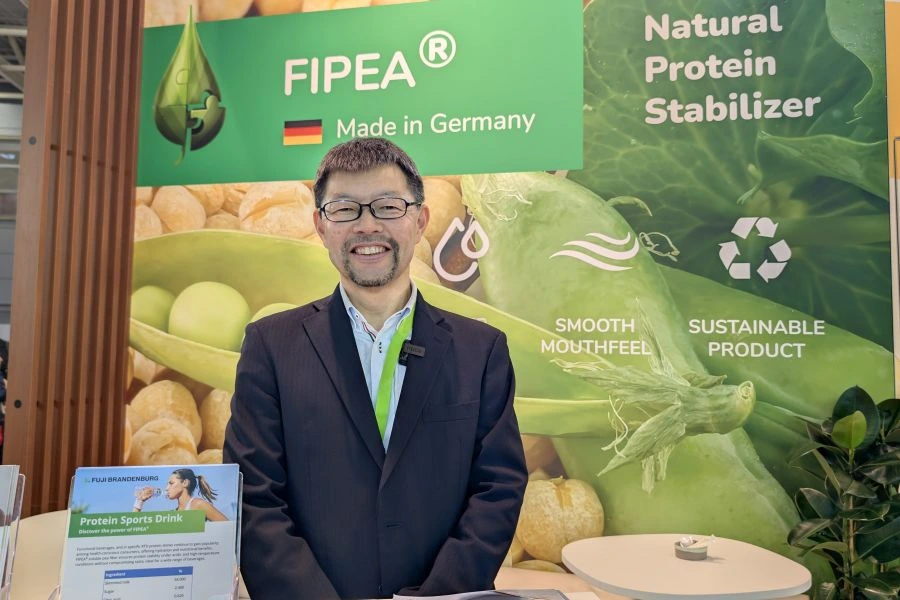 Scott Kato, managing director at Fuji Brandenburg.Translating know-how to Europe
Kato said the inspiration for the ingredient came from Fuji Brandenburg’s parent company, which is headquartered in Osaka, Japan. Fuji Oil originally mastered the technology to achieve this functionality with soy ingredients. Appealing to the European market, the company translated its method to pea.
“Pea is a trusted ingredient in the European market, and it can be locally sourced,” said Kato. All of the raw materials for FiPea’s production come from Germany, where the ingredient is manufactured. It is also made from upcycled material that is leftover from pea protein and starch production, contributing to its sustainability story.
The company is currently awaiting an E number, so that the ingredient can be used commercially as a stabilizer.
“EFSA has already finished the evaluation, and Fuji Oil is awaiting final registration,” added Kato. Once finalized, brands will be able to list the product but its E number or “pea fiber concentrate” on the label.
Although beverages were the main highlight at FiE, the ingredient has a place in bakery and processed rice products by keeping them soft, moist, and fresher for longer, highlighted Kato.
Soluble pea starch as a flavor carrier
Pea ingredient specialist Roquette is also investigating more functional and clean label ways of leveraging its plant-based ingredients.
The company just launched Amysta L 123, which is the first ingredient in a new range of functional plant-based solutions for cleaner labels.
 Valerie Le Bihan, head of customer marketing EMEA RoquetteThe soluble pea starch works in dry powder applications to provide bulk, enhance mouthfeel, and act as a flavor carrier. “The ingredient can be used to replace ingredients that consumers may perceive as less desirable, like modified starches, maltodextrin, or other texturizers,” said Valérie Le Bihan, head of customer marketing EMEA Roquette.
“Our new clean labor texturizing solution is a soluble pea starch created with just a thermal treatment. There are no enzymes or chemicals involved, so it’s truly a clean label solution that is resistant to additional heat treatments.”
Off-site from Fi Europe, Roquette demoed the new ingredient in an instant tomato soup.
“With this soluble starch, consumers get the right mouthfeel they expect in such a soup. It’s very easy to dissolve and disperse, that’s why it suits instant soups, but it works in any type of dry mix,” Le Bihan explained.
Clean label for who?
Le Bihan pointed out that formulating clean labels is a moving target. What’s considered desirable in one application may be undesirable in another, she said.
“In sports nutrition, consumers look for ingredients like maltodextrin to give them nutritional benefits, such as hydration or energy management. But when it comes to applications like soup, consumers expect recognizable pantry ingredients.”
Recognizing that maltodextrin can be negatively perceived by some consumer groups, Le Bihan said the company sought to develop ingredients that match the needs of its consumers. “We launched Amysta L 123 to provide a reassuring option. It can be labeled in Europe as soluble pea starch or in the US simply as pea starch.”
To be sure, Roquette conducted a consumer survey on consumer perception of the ingredient on the label, with positive results that they can share with customers, reported Le Bihan.
Replacing phosphates in meat products
Yeast ingredients have proven to be a powerhouse of innovation in recent years, going beyond savory flavors into protein enrichment. Most recently, Brazil-based Biorigin developed a solution based on yeast extracts that can replace the need for phosphates in processed meats.
 Alexandre Lemos Raszl, food application manager at Biorigin, presented crispy chicken bites with and without phosphates to Food Ingredients First.Phosphates are currently used in meats to give them more succulence and improve freshness.
At Fi Europe, the company showcased crispy chicken bites using its yeast extract solution. The trifold strategy combines Bionis YE MXE NS, Biotaste CH, and Bionis YE NS Pro to enhance umami, mouthfeel, and chicken flavor, while masking off-notes and improving juiciness. Biorigin presented its new solution at the Biospringer by Lesaffre stand, under the new umbrella initiative, “We are food lovers.”
In addition to phosphates not being a “clean label” product, Biorigin pointed to mounting concern for using the additive due to environmental, ethical, and health reasons.
Manoel Carniel, market intelligence specialist at Biorigin, called the use of phosphates “a critical point for the food industry” that is currently being overlooked.
Phosphate rock is a finite, non-renewable resource, and about 90% of what is extracted globally is destined for food production. Its mining comes at significant environmental and social costs, according to Biorigin.
The company highlighted that mining operations contribute to pollution, radioactive contamination, and excessive water use that impact the health of surrounding communities.
Additionally, excessive phosphate intake can increase phosphorus absorption in the body, which may increase the risk of osteoporosis, heart disease, and negatively impact the kidneys.
Mitigating volatility
Alexandre Lemos Raszl, food application manager at Biorigin also pointed out that supply and prices for the ingredient have been volatile, putting food producers under pressure to find reliable solutions. This issue may be in part due to the unequal distribution of the natural resource.
According to the UN Environment Programme, about 85% of all phosphate rock is controlled by Morocco, China, South Africa, and the US. The remaining reserves contain more impurities and are harder to access, underscoring the need for alternatives.
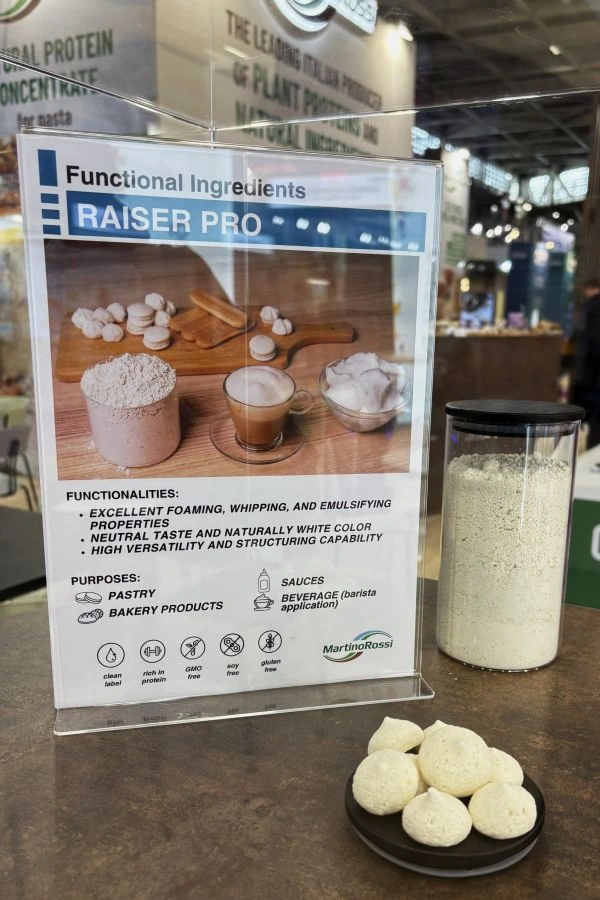 Chickpea ingredients are highly functional for replacing egg whites. Ingredients to replace unstable supply chains were another top theme at the European trade show, as Biorigin and Angel Yeast both proposed yeast ingredients to reduce cocoa. Shortages of eggs in recent years has also driven the discovery of plant-based ingredients that can replace the multifunctionality of eggs, through the use of ingredients like potato protein and aquafaba.
Positioning the ingredient as an eggwhite replacement, Italy-based MartinoRossi showcased its Raiser Pro chickpea protein as a highly functional ingredient. The company presented plant-based meringue to demonstrate the plant-based protein’s “excellent foaming, whipping, and emulsifying properties.”
The ingredient is also neutral in taste and naturally white in color, making it ideal for pastry, bakery, sauces, and beverages.
Meanwhile, Angel Yeast spotlighted its yeast protein range, which varies from 50–90% protein. Winston Sun, who is the global product manager of Angel Yeast Europe, revealed that some of these proteins have special properties like foaming and good solubility, making them widely versatile for health and functionality.